Showing posts with label muay thai. Show all posts

1/18/2009

Thai Food, Beef Panang Curry[Panang Neur]

Panang curry is slightly different from the other coconut milk curries in that it has a thicker sauce from an amazing array of dried spices. It combines some herbs such as basil leaves , red chilli and kaffir lime leaves.

Beef Panang Ingredients

1. 400 grams beef tenderloin, sliced

2. 2 tablespoons panang curry paste

3. 2 tablespoons vegetable cooking oil

4. 150 gms coconut milk

5. 2 tablespoons palm sugar

6. 2 tablespoons fish sauce

7. 10 basil leaves

8. 1 red chilli, sliced

9. 3 kaffir lime leaves

Beef Panang Preparations

1. Heat the oil in a wok and fry the curry paste for one minute, then pour in the coconut milk and boil.

2. Add beef and season with palm sugar and fish sauce.

3. Once the beefs are cooked, then add basil, chilli and kaffir lime leaves. Transfer to a serving bowl. Serve with steamed rice is also a good way to enjoy this recipe.

by: http://www.thaifooddb.com


Muay Thai or Thai boxing, How it is amazing?

You might have heard about it, or even seen it on TV—the furious punches, crushing elbow strikes, lethal kicks, powerful grappling and artful feints. But nothing compares to seeing them executed to loud cheers and heart-racing tune of an accompanying wind-and-percussion ensemble. Welcome to the exciting world of Muay Thai, a martial art like no others, and a proud heritage of a nation.

The history of Thai culture, Muay Thai is interwoven with the history of the Thai people. A gentle, peace-loving people, for centuries Thais had to defend themselves and their land from aggressive powers. They developed a form of close, hand-to-hand combat best suited for the kind of rough-terrain battle they were fighting. Over time it became a rite of passage for Thai men to take up training in this martial art. King Naresuan the Great (1555-1605), one of the country’s most celebrated warrior-heroes, is believed to have been an excellent boxer himself, and it was he who made Muay Thai a required part of military training. Another milestone in the history of Muay Thai was the triumph of Nai Khanom Tom over 10 Burmese boxers in 1774. Taken captive after the Thai capital fell in 1767, Nai Khanom Tom was picked to fight before the Burmese king. After defeating ten of them in a row, he was freed and returned home a hero.

In the old days, Muay Thai was a dangerous sport, with no safety gear of any kind for the fighters, and only lengths of cords to wrht: bold;">Muay Thai Council was set up by cabinet resolution in 1995 to promote this national heritage at national and international levels. At a conference held that same year, 78 member countries voted for the establishment of a training school where all elements of Muay Thai would be taught. The Muay Thai Institute was founded in 1997 and is now the only training school accredited by the Ministry of Education.

Muay Thai or Thai boxing with international passion


Muay Thai, along with soccer, is certainly the most passionately followed sport in the country. Television networks broadcast fights five days a week, and the fight results at major stadiums are reported in all major newspapers. International boxing is also very popular, and the country has produced dozens of world champions, but they all started out as Muay Thai fighters. So it is not surprising that a boy as young as seven or eight would start training to become one—and many do, at stables across the country. Most provincial capitals have a boxing ring, but the ultimate dream of young boxers is to fight at Lumpini or Ratchadamgside tickets going for 500 baht each. Fights usually begins around 6:30 p.m., with preliminary bouts featuring younger, less experienced boxers, and build up towards the main event, usually around nine o’clock.

Muay Thai is fought in five three-minute rounds with two-minute breaks in between. The fight is preceded by a wai khru dance, in which each contestant pays homage to his teachers. Besides the younger, less experienced boxers, and build up towards the main event, usually around nine o’clock.

Muay Thai is fought in five three-minute rounds with two-minute breaks in between. The fight is preceded by a wai khru dance, in which each contestant pays homage to his teachers. Besides the symbolic meaning, the dance is a good warm-up exercise. You will notice that each boxer wears a headband and armbands. The headband, called mongkhol, is believed to bestow luck to the wearer since it has been blessed by a monk or the boxer’s own teacher. Since Buddhism and the teacher play important roles in the life of Thais, the headband is both a lucky charm and a spiritual object. It will be removed after the wai khru dance, and only by the boxer’s trainer. The armbands, meanwhile, are believed to offer protection and are only removed when the fight has ended.

A match is decided by a knockout or by points. Three judges decide who carries the round and the one who wins the most rounds, win the fight. The referee plays a very important role, since boxers’ safety depends on his decision.

To one side of the ring is the band section, comprising a Javanese clarinet, drums and cymbals. They accompany the fight from the homage dance to the conclusion. The tempo goes up as the action inside the ring intensifies. The musicians are mostly old-timers who have seen just about anything, yet their music always makes the heart race faster. It is said that the tune is a siren song that the true Muay Thai devotee can never resist.

On fight nights at major stadiums, especially at Lumpini and Ratchadamnoen, tourists fill up a sizable portion of the seats, and the number is growing. Most opt to sit at ringside, to see the action up close. On nights of major events, usually advertised days in advance, it can be hard to get tickets. You might want to book through your hotels or travel agents.

by: http://bangkok.sawadee.com

1/17/2009

Thai Boxing, Conditioning

Like most competitive full contact fighting sports, Muay Thai has a heavy focus on body conditioning. Muay Thai is specifically designed to promote the level of fitness and toughness required for ring competition. Training regimens include many staples of combat sport conditioning such as running, shadowboxing, rope jumping, body weight resistance exercises, medicine ball exercises, abdominal exercises, and in some cases weight training. Muay Thai practitioners typically apply Namman Muay liberally before and after their intense training sessions.

Training that is specific to a Muay Thai fighter includes training with coaches on Thai pads, focus mitts, heavy bag, and sparring. The daily training includes many rounds (3-5 minute periods broken up by a short rest, often 1-2 minutes) of these various methods of practice. Thai pad training is a cornerstone of Muay Thai conditioning which involves practicing punches, kicks, knees, and elbow strikes with a trainer wearing thick pads which cover the forearms and hands. These special pads are used to absorb the impact of the fighter’s strikes and allow the fighter to react to the attacks of the pad holder. The trainer will often also wear a belly pad around the abdominal area so that the fighter can attack with straight kicks or knees to the body at anytime during the round.

Focus mitts are specific to training a fighter’s hand speed, rous fighting and training regimen (some Thai boxers fight almost every other week) professional Muay Thai fighters have relatively short careers in the ring. Many retire from competition to begin instructing the next generation of Thai fighters. It is a common myth that Thai boxing causes arthritis, this is not true and is in no way more damaging to the body than other sports such as karate or even running. Most professional Thai boxers come from the lower economic backgrounds and the fight money (after the other parties get their cut) is sought as means of support for the fighters and their families. Very few higher economic strata Thais ikipedia.org/wiki/Karate" title="Karate">karate or even running. Most professional Thai boxers come from the lower economic backgrounds and the fight money (after the other parties get their cut) is sought as means of support for the fighters and their families. Very few higher economic strata Thais join the professional Muay Thai ranks; they usually either don't practice the sport or practice it only as amateur Muay Thai boxers.

by: http://en.wikipedia.org

1/16/2009

Thai Boxing, Punches and kicks

Defensively, the concept of "wall of defence" is used, in which shoulders, arms and legs are used to hinder the attacker from successfully executing techniques. Blocking is a critical element in Muay Thai and compounds the level of conditioning a successful practitioner must possess. Low and mid body roundhouse kicks are normally blocked with the upper portion of a raised shin. High body strikes are blocked with the forearm/glove, elbow/shin. Mid section roundhouse kicks can also be caught/trapped, allowing for a sweep or counter attack to the remaining leg of the opponent. Punches are blocked with an ordinary boxing guard and techniques similar, if not identical, to basic boxing technique. A common means of blocking a punch is using the hand on the same side as the oncoming punch. For example, if an orthodox fighter throws a jab (being the left hand), the defender will make a slight tap to redirect the punch's angle with the right hand. The deflection is always as small and precise as possible to avoid unnecessary energy expenditure and return the hand to the guard as quickly as possible. Hooks are most often blocked with a motion most often described as "combing your hair," raising the elbow forward and effectively shielding the head with the forearm, flexed biceps, and shoulder. More advanced Muay Thai blocks are usually counters, used to damage the opponent to prevent another attack being made.

by: http://en.wikipedia.org

Thai Boxing, Defense against attacks


Defense against attacks

Defenses in Muay Thai are categorised in 6 groups:

  • Blocking - defender's hard blocks to stop a strike in its path so preventing it reaching its target, (eg the Shin Block described in more detail below)
  • Redirection - defender's soft parries to change the direction of a strike (eg a downwards tap to a jab) so that it misses the target
  • Avoidance - moving a body part out of the way or range of a strike so the defender remains in range for a counter-strike, eg defender moving the front leg backwards from the attacker's low kick: then immediately counter-attacking with an angle kick: or defender laying the head back from the attacker's high angle kick: then immediately counter-attacking with a side kick from the front leg:
  • Evasion - moving the body out of the way or range of a strike so the defender has to move close again to counter-attack, eg defender jumping back from attacker's kicks
  • Disruption - Pre-empting an attack. eg with defender using disruptive techniques like jab, teep or low angle kick (to the inside of the attacker's front leg) as the attacker attempts to close distance
  • Anticipation - Defender catching a strike (eg catching an angle kick to the body) or countering it before it lands (eg defender's low kick to the supporting leg below as the attacker iniates a high angle kick).

1/14/2009

Thai Boxing, Foot-thrust (teep), Clinch

Foot-thrust (teep) Foot-Thrusts also known as Push Kicks or literally "foot jabs" are one of the most common techniques used in Muay Thai. Teeps are different from any other Muay Thai technique in terms of objective to use. Foot-thrusts are mainly used as a defensive technique to control distance, block attacks, and get an opponent off balance. Foot-Thrusts should be thrown quickly but yet with enough force to knock an opponent off balance.

Clinch

In Western Boxing the two fighters are separated when they clinch; in Muay Thai, however, they are not. It is often in the clinch where knee and elbow techniques are used. The front clinch should be performed with the palm of one hand on the back of the other. There are three reasons why the fingers must not be intertwined. 1) In the ring fighters are wearing boxing gloves and cannot intertwine their fingers. 2) The Thai front clinch involves pressing the head of the opponent downwards, which is easier if the hands are locked behind the back of the head instead of behind the neck. Furthermore the arms should be putting as much pressure on the neck as possible. 3) A fighter may incur an injury to one or more fingers if they are intertwined, and it becomes more difficult to release the grip in order to quickly elbow the opponent's head.

A correct clinch also involves the fighter's forearms pressing against the opponent's collar bone while the hands are around the opponent's head rather than the opponent's neck. The general way to get out of a clinch is to push the opponent's head backwards or elbow him or her, as the clinch requires both participants to be very close to one another. Additionally, the non-dominant clincher can try to "swim" his or her arm underneath and inside the opponent's clinch, establishing the previously non-dominant clincher as the dominant clincher.

Muay Thai has several other variants of the clinch, including:

  • arm clinch, where one or both hands controls the inside of the defender's arm(s) and where the second hand if free is in the front clinch position, this clinch is used to briefly control the opponent before applying a knee strike or throw
  • side clinch, one arm passing around the front of the defender with the attacker's shoulder pressed into the defender's arm pit and the other arm passing round the back which allows the attacker to apply knee strikes to the defender's back or to throw the defender readily
  • low clinch, with both controlling arms passing under the defender's arms, which is generally used by the shorter of two opponents
  • swan-neck where one hand around the rear of the neck is used to briefly clinch an opponent (before a strike)
by: http://en.wikipedia.org

Thai Boxing, Knee (Tee kao)

  • Kao Dode (Jumping knee strike) - the Thai boxer jumps up on one leg and strikes with that leg's knee.
  • Kao Loi (Flying knee strike) - the Thai boxer takes step(s), jumps forward and off one leg and strikes with that leg's knee.
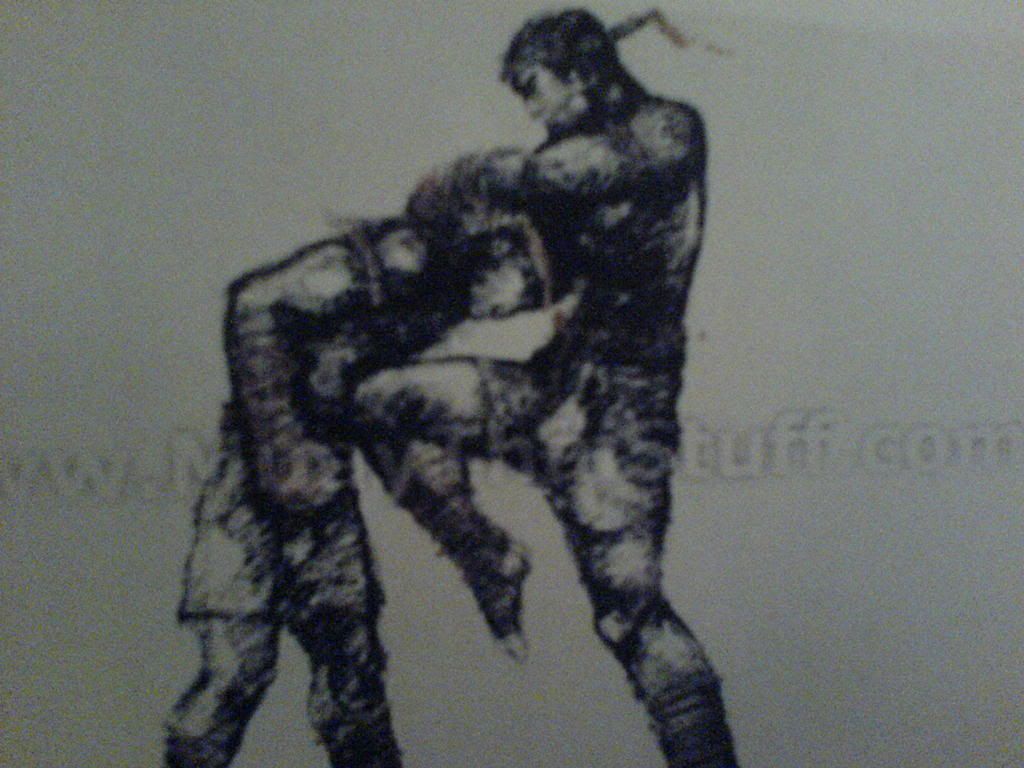
  • Kao Tone (Straight knee strike) - the Thai boxer simply thrusts it forward (not upwards, unless he is holding an opponents head down in a clinch and intend to knee upwards into the face). According to one written source, this technique is somewhat more recent than Kao Dode or Kao Loi.[citation needed] Supposedly, when the Thai boxers fought with rope-bound hands rather than the modern boxing gloves, this particular technique was subject to potentially vicious cutting, slicing and sawing by an alert opponent who would block it or deflect it with the sharp "rope-glove" edges which are sometimes dipped in water to make the rope much stronger. This explanation also holds true for some of the following knee strikes below as well.

The clinch version of this move was scientifically proven recently, by National Geographic Channel's Fight Science, to be the strongest blow using the legs in martial arts. The test subject, Melchor Menor, delivered the strike to a high-tech dummy. On a person the blow would have fragmented the ribs, caused two inches of chest compression, and caused severe internal bleeding in the organs.

  • Kao Noi (Small knee strike) - the Thai boxer hits the inside upper thigh (above the knee) of the opponent when clinching. This technique is used to wear down the opponent or to counter the opponent's knee strike or kick.
by: http://en.wikipedia.org

1/12/2009

Thai Boxing, Kicking (Teh)


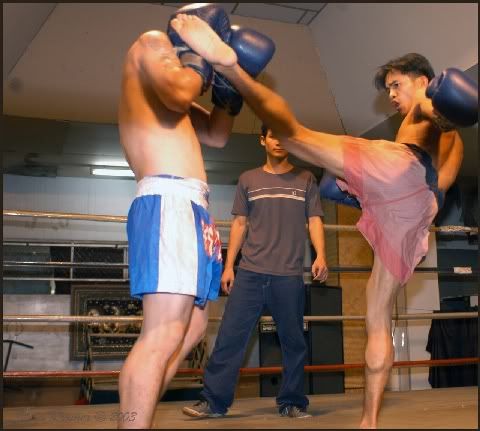
The two most common kicks in Muay Thai are known as the teep (literally "foot jab,"), and the Teh(kick)chiang (kicking upwards in the shape of a triangle cutting under the arm and ribs) or angle kick. The Muay Thai angle kick has been widely adopted by fighters from other martial arts. The angle kick uses a rotational movement of the entire body. The angle kick is superficially similar to a karate roundhouse kick, but omits the rotation of the lower leg from the knee used in other striking martial arts like Karate or Taekwondo. The angle kick draws its power entirely from the rotational movement of the body. Many Muay Thai fighters use a counter rotation of the arms to intensify the power of this kick.If a round house kick is attempted by the opponent the Muay Thai fighter will normally block with his shin. Thai boxers are trained to always connect with the shin. While sensitive in an unconditioned practitioner, the shin is the strongest part of the leg for experienced Muay Thai fighters. The foot contains many fine bones and is much weaker. A fighter may end up hurting himself if he tries to strike with his foot or instep.

Muay Thai also includes other varieties of kicking, such as the axe kick, side kick or spinning back kick etc. These kicks are only used in bouts by some fighters. It is worth noting that a side kick is performed differently in Muay Thai than the traditional side kick of other martial arts. In Muay Thai, a side kick is executed by first raising the knee of the leg that is going to kick in order to convince the opponent that the executor is going to perform a teep or front kick. The hips are then shifted to the side to the more traditional side kick position for the kick itself. The "fake-out" almost always precedes the kick in Muay Thai technique.

by: http://en.wikipedia.org

1/11/2009

Thai Boxing, Elbow (Tee sok)

Elbow (Tee sok) The elbow can be used in seven ways: horizontal, diagonal-upwards, diagonal-downwards, uppercut, downward, backward-spinning and flying. From the side it can be used as either a finishing move or as a way to cut the opponent's eyebrow so that blood might block his vision. The blood also raises the opponent's awareness of being hurt which could affect his performance. This is the most common way of using the elbow. The diagonal elbows are faster than the other forms, but are less powerful. The uppercut and flying elbows are the most powerful, but are slower and easier to avoid or block. The downward elbow is usually used as a finishing move.

Elbow Slash, Horizontal Elbow, Uppercut Elbow, Forward Elbow Thrust, Reverse Horizontal Elbow, Spinning Elbow, Elbow Chop, Double Elbow Chop, Mid-Air Elbow Strike

There is also a distinct difference between a single elbow and a follow-up elbow. The single elbow is an elbow move independent from any other move, whereas a follow-up elbow is the second strike from the same arm, being a hook first with an elbow follow-up. Such elbows, and most other elbows, are used when the distance between fighters becomes too small and there is too little space to throw a hook at the opponent's head.

by: http://en.wikipedia.org/

1/10/2009

Thai Bixing, Muay Thai techniques

In its original form, Muay Thai consisted of an arsenal of nine weapons - the head, fists, elbows, knees and feet - known collectively as na-wa arwud. However in modern Muay Thai, both amateur and professional, headbutting an opponent is no longer allowed.

To strike and bind the opponent for both offensive and defensive purposes, small amounts of stand-up grappling are used: the clinch. Formal Muay Thai techniques are divided into two groups: Mae Mai or major techniques and Luk Mai or minor techniques. Muay Thai is often a fighting art of attrition, where opponents exchange blows with one another. This is certainly the case with traditional stylists in Thailand, but is a less popular form of fighting in the contemporary world fighting circuit. With the success of Muay Thai in mixed martial arts fighting, it has become the de facto martial art of choice for competitive stand-up fighters. As a result, it has evolved and incorporated much more powerful hand striking techniques used in western style boxing and the Thai style of exchanging blow for blow is no longer favorable. Note: when Muay Thai fighters compete against fighters of other styles (and if the rules permit it), they almost invariably emphasize elbow (sok) and knee (kao) techniques to gain a distinct advantage in fighting. Almost all techniques in Muay Thai use the entire body movement, rotating the hip with each kick, punch, and block. The rotation of the hips in Muay Thai techniques, and intensive focus on "core muscles" (such as abdominal muscles and surrounding muscles) is very distinctive and is what sets Muay Thai apart from other styles of martial arts.

Punching (Chok)

In boxing, a cross (also commonly called a "straight") is a power-punch like the uppercut and hook. Compubox, a computerized punch scoring system, counts the cross as a power-punch.

It is a punch usually thrown with the dominant hand the instant an opponent leads with his opposite hand. The blow crosses over the leading arm, hence its name.

Technique
From the guard position, the rear hand is thrown from the chin, crossing the body and travelling towards the target in a straight line. The rear shoulder is thrust forward and finishes just touching the outside of the chin. At the same time, the lead hand is retracted and tucked against the face to protect the inside of the chin. For additional power, the torso and hips are rotated anti-clockwise (for righties) as the cross is thrown. Weight is also transferred from the rear foot to the lead foot, resulting in the rear heel turning outwards as it acts as a fulcrum for the transfer of weight. Body rotation and the sudden weight transfer is what gives the cross its power. Like the jab, a half-step forward may be added. After the cross is thrown, the hand is retracted quickly and the guard position resumed. It can be used to counterpunch a jab, aiming for the opponent's head (or a counter to a cross aimed at the body) or to set up a hook. The cross can also follow a jab, creating the classic "one-two combo." The cross is also called a "straight" or "right."

Hook (Thai Boxing)

A hook is a punch in boxing. It is performed by turning the core muscles and back, thereby swinging the arm, which is bent at an angle near or at 90 degrees, in a horizontal arc into the opponent. A hook is usually aimed at the chin, but it can also be used for body shots, especially to the liver.

Hook punches can be thrown by either the lead hand or the rear hand, but the term used without a qualifier usually refers to a lead hook.

When throwing a hook, the puncher shifts his body weight to the rear, or supporting foot, allowing him to pivot his lead foot and torso, swinging his lead fist horizontally toward the opponent. Sometimes, depending on style and what feels comfortable to the individual, the lead foot is not pivoted. Pivoting increases the power of the punch, but leaves one lacking in options to follow up with, such as the right uppercut or right hook.

A hook
The hook is a powerful
punch with knockout power.

Variations of the hook are the shovel hook or upper-hook; they are body punches that combine characteristics of both the hook and the uppercut.

Swing (Thai Boxing)

The swing is a type of hook, with the main difference being that in the swing the arm is usually more extended.

Uppercut (Thai Boxing)

The uppercut (sometimes also referred to as the upper) is a punch used in boxing that usually aims at the opponent's chin. It is, along with the cross, one of the two main punches that count in the statistics as power punches.

Uppercuts are useful when thrown at close range, because they are considered to cause more damage when at close range. Additionally, it is likely that a boxer would miss if the uppercut is thrown when the opponents are apart. Uppercuts usually do more damage when landed to the chin, but they can also cause damage when thrown to the body (particularly the solar plexus) or when landing on the nose or eyes.

As far as the punch's movement, the name says it all: the punch usually initiates from the attacker's belly, making an upward motion that resembles a pirate's hook in shape, before landing on the opponent's face or body. In a conventional boxing combination, it is the second punch thrown, after the jab, but it can either initiate or finish a combination.

Lead hand uppercut

When performing an uppercut, the attacker should stay close to the target, so as to prevent the opponent from detecting that the punch is coming, and countering with a straight punch. An uppercut from the outside also loses some of its power because the arm is no longer bent at the elbow and cannot effectively transfer the total body’s force in the upward movement.[1]

Boxers famous for their uppercuts include Joe Louis, Wilfredo Gómez, Julio César Chávez, Mike Tyson, Ruben Olivares, and Manny Pacquiao.

Superman Punch

A superman punch or cobra punch is a technique used in Muay Thai and mixed martial arts fighting. The technique involves bringing the rear leg forward to feign a kick, then snapping the leg back while throwing a cross, resulting in greater power behind the punch.

Undercut (Thai Boxing)

A punch that usually hits the opposing fighters chin in an upwards fashion.
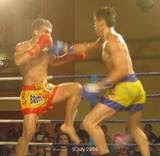
An upwards-thrown punch designed to hit an opponent's chin; usually part of a multi-punch combination and best used when a boxer is very close to his opponent. Dutch Sam is credited with creating this punch; it was called an "undercut" then. Today it is known as un uppercut.

The punch techniques in Muay Thai were originally quite simple being crosses and a long (or lazy) circular strike made with a straight (but not locked) arm and landing with the heel of the palm. Cross-fertilization with Western boxing and western martial arts mean the full range of western boxing punches are now used: jab, straight right/cross, hook, uppercut, shovel and corkscrew punches and overhands as well as hammer fists and back fists.

As a tactic, body punching is used less in Muay Thai than most other striking martial arts to avoid exposing the attacker's head to counter strikes from knees or elbows.

by: http://en.wikipedia.org


1/09/2009

Thai tourist attraction, Ritual Dance of Homage (Wai Khru Ram Muay)

Wai Khru Muay Thai is a tradition which goes back to ancient times, it is not an optional ritual or reserved for special occasions: the official Muay Thai regulations specify that both fighters must perform the Wai Khru Ram Muay before each and every bout. It's a tradition in which fighters pay respect to their teachers, parents and things they hold sacred and pray for their safety and victory. The ritual has been developed in different ways, in different regions, even under different teachers and therefore it is theoretically impossible for two fighters to perform identical Wai Khru.

The Wai Khru is graceful and aesthetic ritual, both practical and spiritual. In a practical sense, it functions as a final pre-fight warm-up and gives the fighter some time alone before the fight to collect his thoughts. It can be divided into three main sections:

The Royal Homage Sequence
This was originally intended to show devotion to the King, going back to the days when fighters were selected to display their skills in front of him. It has three subsections: Prostration, Outstretched Arms and Act of Homage.

The Kneeling Sequence
This section is performed in a kneeling posture, one knee on the ground and the other leg out in front. the fighter pivots around on the spot to repeat the same sequence facing all four sides of the ring, a tradition which comes from Krabi Krabong.

The Standing Sequence
In this section, the fighters go out from the center of the ring in one direction, to perform the Dramatic Interlude. Some fighters imitate the motions of "Rama Shooting an Arrow" from the Ramakien, a hunter, a soldier, or an executioner. Some fighters use this ritual to attempt to scare their opponents, commonly by stomping around them. But in a deeper sense, the fighter is expressing religious devotion, humility, and gratitude. Transcending both physical and temporal limitations, he opens himself to the divine presence and allows it to infuse his heart.

Removal of the Head Circlet (Pitee Tod Mongkon)
After the Wai Khru is completed, the fighters return to their own corners for the Removal of the Head Circlet Ritual (Pitee Tod Mongkon). The fighter stands in his own corner, lowers his head and raises hands to his chest for panom mue wai pose, while khru muay standing outside of the ropes facing the fighter, raises his own hands to return the wai. A fighter maintains the posture while the teacher utters an incantation and blows three times on top of fighters' head before removing the Mongkon. On the completion of this ritual and after a review of the rules by the judge and a glove shake, the contest may begin.

by: http://en.wikipedia.org

Approaching the Ring Rites (Kuen Suu Weitee)

In ancient times, Siamese people believed in the power of incantations and protective amulets, the common belief was that everything was ruled and inhabited by unseen spirits, and that places were either blessed or cursed. Because of these beliefs, it was necessary to perform special rites before a fighter entered the ring, asking the spirits' permission to do so.

Even today, before entering the ring many fighters perform rituals. It is very much a matter of individual preference these days, with no prescribed rules. Some may kneel before the ring, others might pray with their khru muay or perform a series of repetitive movements, such as touching the ring ropes 3 times and avoiding the bottom stair before taking the first step up to the ring.

Fighters always leap over the ropes into the ring, because the head is considered to be more important than the feet and therefore it has to stay always above the feet while entering the ring, then they will go to the center and pay respect (panom muae wai) in all four directions to the spectators.

by: http://en.wikipedia.org


1/08/2009

Thai Boxing, Tradition of Wai Khru

One of the most Thai tourist attraction, One of the most important traditions of Muay Thai is Wai Khru (Paying Respect to Teachers). In order to become a fully-fledged Muay Thai fighter, a person has to pass through a series of ceremonies. First comes the Initiation as a Trainee Fighter Ceremony (Kuen Khru), in which the khru muay accepts young fighters as his students and pledges to teach them to the best of his ability. After fighters have been accepted, they must demonstrate a good conduct, diligence and endurance, in addition to training as hard as they can, following implicitly all the teacher's rules.

During their apprenticeship, young fighters will experience the second type of Wai Khru ritual, the Annual Homage-Paying Ceremony (Wai Khru Prajam Pee). This annual ceremony is usually held on Muay Thai Day (March 17) for young fighters to pay respect to their teachers and souls of teachers long passed away. The ceremony then progresses to the students honoring all the teachers present, who will mark sacred symbols on the fighters' forehead in order to bestow prosperity and success upon them - a custom known as jerm. The ceremony culminates with the third form of Wai Khru, the Ritual Dance of Homage (Wai Khru Ram Muay) performed by the fighters as a mark of respect.

It is only when fighters have passed all these three milestones (initiation, training and participation in contests) that they are entitled to call themselves as real Muay Thai fighters. When fighters have satisfied their teachers on all these counts, then they can participate in the fourth Wai Khru ritual, the Initiation as a Teacher Ceremony (Khrob Khru), which bestows on them the rank of khru muay and again involves a performance of the Ritual Dance of Homage.

by: http://en.wikipedia.org

12/26/2008

Thai Boxing, Legendary heroes


At the time of the fall of the ancient Siam capital of Ayutthaya in 1763, the invading Burmese troops rounded up a group of Thai residents and took them as prisoners. Among them were a large number of Thai boxers, who were taken by the Burmese to the city of Ungwa.

In 1774, in the Burmese city of Rangoon, the king of the Burmese, King Mangra decided to organize a seven-day, seven-night religious festival in honor of Buddha's relics. The festivities included many forms of entertainment, such as the costume plays called likay, comedies and farces, and sword-fighting matches. At one point, King Mangra wanted to see how Muay Boran would compare to the Burmese art Lethwei. Nai Khanom Tom was selected to fight against the Burmese champion. The boxing ring was set up in front of the throne and Nai Khanom Tom did a traditional Wai Kru pre-fight dance, to pay his respects to the Burmese king, as well as for all the spectators, dancing around his opponent, which amazed and perplexed all the Burmese people. When the fight began, he charged out, using punches, kicks, elbows, and knees, pummeling his opponent until he collapsed.[1]

The referee however stated that the Burmese opponent was too distracted by the Wai Kru, and the knockout was invalid. The King then asked if Nai Khanom Tom would fight nine other Burmese champions to prove himself. He agreed and fought them all, one after the other with no rest periods in between. His last opponent was a great boxing teacher from Ya Kai City. Nai Khanom Tom mangled him by his kicks and no one else dared to challenge him any further.

King Mangra was so impressed that he remarked, "Every part of the Thai is blessed with venom. Even with his bare hands, he can fell nine or ten opponents. But his Lord was incompetent and lost the country to the enemy. If he would have been any good, there was no way the City of Ayutthaya would ever have fallen."

King Mangra granted Nai Khanom Tom freedom along with either riches or two beautiful Burmese wives. Nai Khanom Tom chose the wives as he said that money was easier to find. He then departed with his wives for Siam. Other variations of this story had him also winning the release of his fellow Thai prisoners. His feat is celebrated every March 17 as "Boxer's Day" or "National Muay Thai Day" in his honor and that of Muay Thai's.

Today, some have wrongly attributed the legend of "Nai Khanom Tom" to King Naresuan, who was once taken by the Burmese. However, Nai Khanon Tom and King Naresuan were almost two centuries apart.

by: http://en.wikipedia.org

Thai Boxing, Muay Renaissance


The ascension of King Chulalongkorn (Rama V) to the throne in 1868 ushered in a Golden Age not only for muay but for the whole country of Thailand. Muay progressed greatly during the reign of Rama V as a direct result of the king's personal interest in the art. The country was at peace and muay functioned as a means of physical exercise, self-defense, recreation, and personal advancement. Masters of the art such as former fighters or soldiers began teaching muay in training camps where students were provided with food and shelter. Trainees would be treated as one family and it was customary for students to adopt the camp's name as their own surname.

After the occurrence of a death in the ring, King Rama the VII pushed for codified rules for Muay Thai, and they were put into place. These included the rules that the fighters should wear modern gloves and cotton coverlets over the feet and ankles. It was also around this time in the 1920s that the term Muay Thai became commonly used while the older form of the style was referred to as Muay Boran.

by: http://en.wikipedia.org

12/25/2008

Merry Christmas & Happy's New Year 2009


Merry Christmas & Happy New's Year for who come to my blog. And especially thanks for my customers. I wish all of you will get the good things for the next year 2009. For the shop on blog in the next year, I will find more discount and more quality products for our customer shopping. I hope you will be more enjoy with our products.

12/24/2008

Thai Boxing, History of Thai Boxing


Various forms of kickboxing have long been practiced throughout Southeast Asia. As with the most countries in the region, Thai culture is highly influenced by ancient civilizations within Southeast Asia. Muay Thai's origin in Thailand can be traced back to its ancestor Muay Boran ("ancient boxing"), an unarmed combat used by Siamese soldiers in conjunction with Krabi Krabong, the weapon-based style. Eventually Muay Boran was divided to:

  • Muay Korat (Northeast) emphasized strength. A technique like "Throwing Buffalo Punch" was used. It could supposedly defeat a buffalo in one blow.
  • Muay Lopburi (Center region) emphasized movements. Its strong points were straight and counter punches.
  • Muay Chaiya (South) emphasized posture and defense, as well as elbows and knees.
  • Muay Pra Nakorn (North) emphasized speed, particularly in kicking. Because of its faster speed, it was called as well "Ling Lom" (windy monkey or Loris).

There is a phrase about Muay Boran that states, "Punch Korat, Wit Lopburi, Posture Chaiya, Faster Thasao. (หมัดหนักโคราช ฉลาดลพบุรี ท่าดีไชยา ไวกว่าท่าเสา)".

As well as continuing to function as a practical fighting technique for use in actual warfare, Muay Thai became a sport in which the opponents fought in front of spectators who went to watch for entertainment. This kind of muay contests gradually became an integral part of local festivals and celebrations, especially those held at temples. It was even used as entertainment to kings.

Eventually, the previously bare-fisted fighters started wearing lengths of rope wrapped around their hands and forearms. This type of match was called muay kaad chuek (มวยคาดเชือก).

by: http://en.wikipedia.org

Thai Boxing, Introduce of Thai Boxing


Muay Thai (Thai: มวยไทย [muāitʰāi], lit. Thai Boxing) is a form of hard martial art practiced in large parts of the world, including Thailand and other Southeast Asian countries. The art is similar to others in Southeast Asia such as: pradal serey in Cambodia, lethwei in Myanmar, tomoi in Malaysia, and Lao boxing in Laos. Muay Thai has a long history in Thailand and is the country's national sport. Traditional Muay Thai practiced today varies significantly from the ancient art muay boran and uses kicks and punches in a ring with gloves similar to those used in Western boxing.

Muay Thai is referred to as "The Art of the Eight Limbs", as the hands, shins, elbows, and knees are all used extensively in this art. A practitioner of Muay Thai ("nak muay") thus has the ability to execute strikes using eight "points of contact," as opposed to "two points" (fists) in Western boxing and "four points" (fists, feet) used in the primarily sport-oriented forms of martial arts.

by: http://en.wikipedia.org